
How an Orillian Facilitated the American Art Pottery Movement
By Fred Blair
In 1850, at 37 years old, Frederick married Anna Brownrigg in Cincinnati, Ohio. He was employed as a bookkeeper in Michael and Nimrod Tempest’s Hamilton Road Pottery. In 1865, Frederick purchased the company. He employed from 10 to 31 potters in making yellow clay ware, like ceramic fruit jars for the canning industry. His pottery was not always stamped with the company name DALLAS.
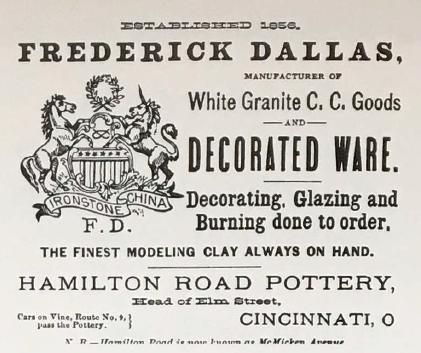
About 1869, Frederick switched production to white clay ware to make finer art pottery. At that time, upper class women were purchasing fired pottery to decorate as a hobby. The advertisement in the image here was directed at those ladies.
In 1876, an exhibition was held in Philadelphia to celebrate the Centennial of the United States. Mrs. McLaughlin and Mrs. Nichols of Cincinnati were inspired by the underglaze art pottery produced in England, France, and Japan and they were both determined to learn the technique.
In 1879, Mary Louise McLaughlin formed the Cincinnati Pottery Club. Maria Longworth Nichols was affronted as she did not receive an invitation to join the club. This created some friction between the two ladies. Mrs. Nichols had rented studio space at Coultry Pottery but had a dispute with them and left. Frederick rented her some of his studio space. Later that year the pottery club moved into Frederick’s Pottery as well. However, his kilns were too hot to fire the finely painted glazed pieces. Mrs. Nichols purchased a kiln to fire over glazes and Mrs. McLaughlin purchased one to fire under glazes. There was artistic rivalry between the two ladies but they shared their special kilns with each other. Both ladies had held the record for the largest vase crafted in the US at about that time.
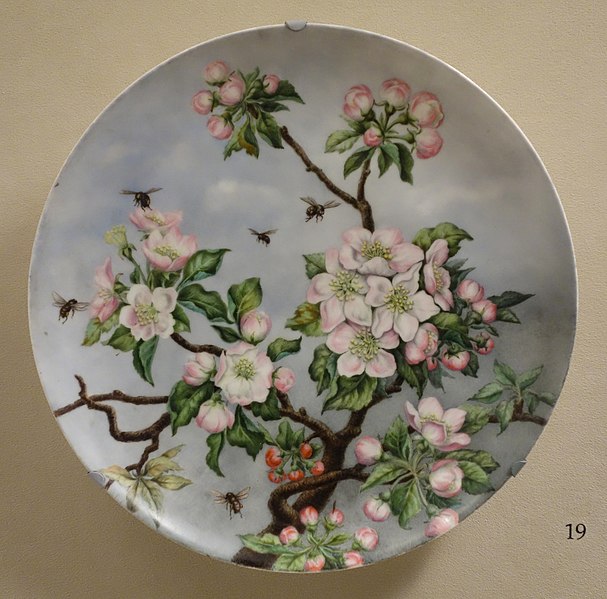
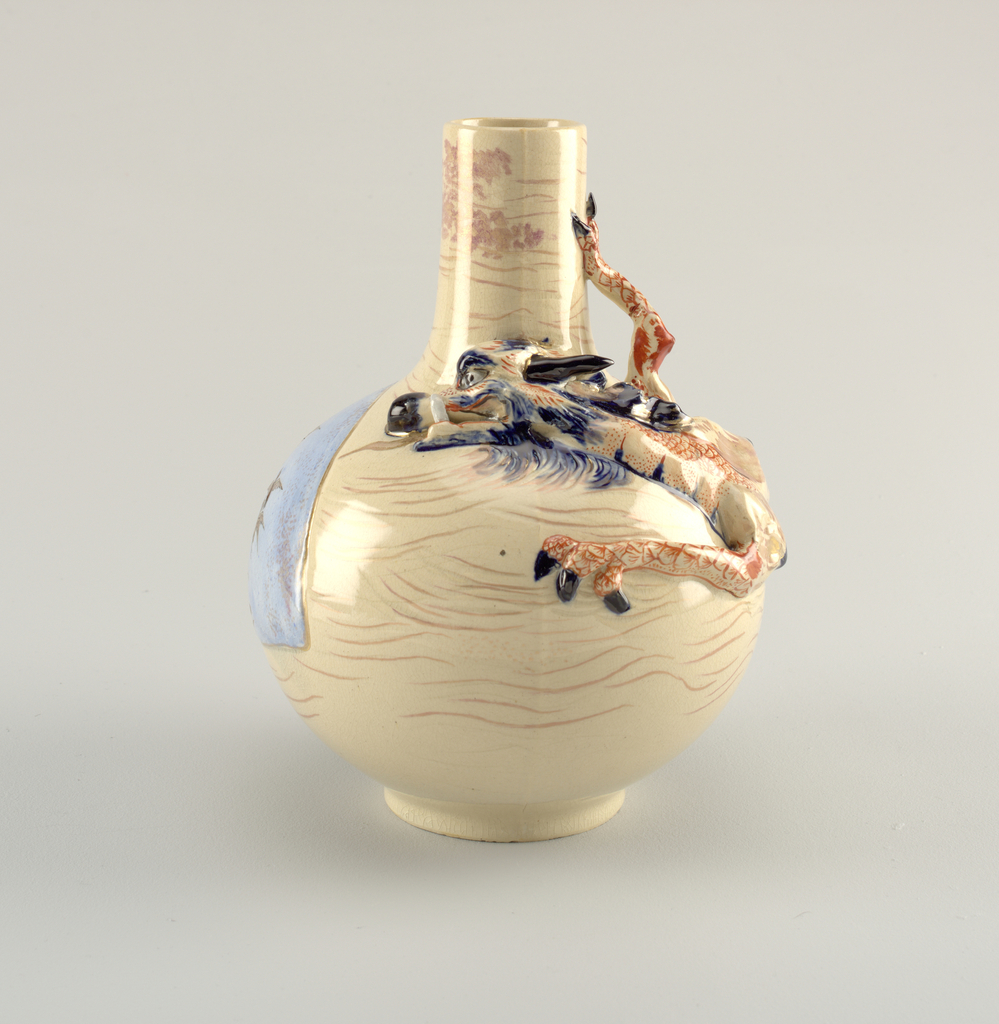
Amanda Merriam’s plaque in the accompanying image was fired in all three types of kilns in the Dallas Pottery in 1882. Mrs. Nichols’ “Dragon Vase”, circa 1879-1880, was fired there as well.
There were over 200 amateur potters in the city and Frederick saw an increasing demand for art pottery in the US. He expanded the size of his pottery production while also investing in clay deposits in several states. The number of potters in his employ increased to over 90 with a similar increase in other staff. His pottery became the largest business in the city. The number of other fine art potteries in the country increased as well and the market for art pottery became saturated in the early 1880s.
On June 9, 1881, Frederick died and his pottery went out of business the following year. Due to the decreased demand for their wares two other large potteries in the city went out of business too. Mrs. Nichols however was undaunted. In 1880, she used family money to purchase a factory and established Rookwood Pottery, which is still in business. If you watch the American Antiques Roadshow, you will have seen some examples of their pottery. Images of these Cincinnati lady’s work can also be found online.
MORE ARTICLES:
What We Have Lost
What We Have Lost By David TownAs we approach the one-year anniversary of the YMCA closing in Orillia, I think it is insightful to see what the Y did for Orillia from a historical perspective. You never know what you’ve lost ‘til it’s gone. The Y in Orillia, as...
Sound as a Barrel
by Ellen Blaubergs, Volunteer, Coldwater Canadiana Heritage Museum There are numerous interesting “works in progress” involving artifacts at the Coldwater Canadiana Heritage Museum, including two wooden barrels once used to transport ceramics. Both are in...
Happy Birthday to Dr. Nancy Ironside!
Happy Birthday to Dr. Nancy Ironside! In honour of her birthday on July 24, we pay tribute to Nancy Retired physician and anesthesiologist, environmentalist, naturalist and... To many, Dr. Nancy Ironside needs no introduction. Without fanfare, Nancy has made a huge...
Two Horse Rides from Orillia to Coldwater
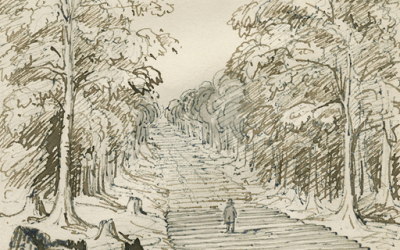
Corduroy Road Over a Swamp in Orillia Township, Ontario Ware, Titus Hibbert, 1810-1890 Picture, 1844, English Pen & brown & blue inks, grey wash, over pencil. Toronto Public Library Digital Archive, in the Public DomainBy Fred Blair Jacob Gill and his...
Community Difference-Maker: Erin Dixon and the Gojijing Roundtable
Community Difference-Maker: Erin Dixon and the Gojijing Roundtable Three thousand years ago, Orillia was populated by the Wendat or Huron people, whose settlement extended all around Lake Couchiching, which they called Gojijing. As colonizers arrived, the lives of...
Andrew Borland, War of 1812 Veteran
By Fred Blair On June 18, 1812, the United States declared war on the British. Many recent American settlers in Upper Canada, like the Borlands, had to consider where their loyalties lay. By law, all the males between 16 and 60 in the province were required to serve...
Thomson Family: John Thomson
By Trish Crowe-Grande, Chair OMAH History CommitteeThe Thomsons, one of Orillia’s influential founding families, rose in prominence in the early days when lumbering was the big industry and dominated the commercial life of the community.Born in Scotland in 1831, John...
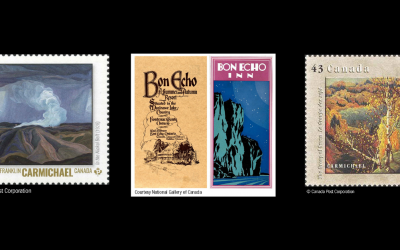
Happy Birthday Franklin Carmichael!
Introduction Happy 131st Birthday, Franklin Carmichael for May 4th, 2021. Fellow Orillians are on a quest to learn more about you. Carmichael was a Renaissance man: husband, father, teacher, philosopher, artist in oil, watercolour and graphite, designer of book...
Sue Mulcahy – 100 Years Young!
Happy Birthday Sue! Lucille (Sue) Mulcahy, stalwart member of our community, turns 100 on March 14th! OMAH and Lakehead University join together to honour Sue and to celebrate her many accomplishments and contributions over those years, that have so enriched...
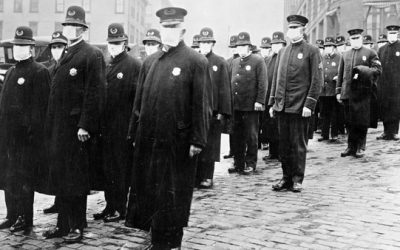
Past Pandemics : How They Have Shaped Us
The current Covid-19 pandemic has caused unprecedented changes in social interaction and commerce. With all the changes resulting from self-isolation, social distancing, travel restrictions, reduced shopping trips, increased on-line shopping, working at home and...